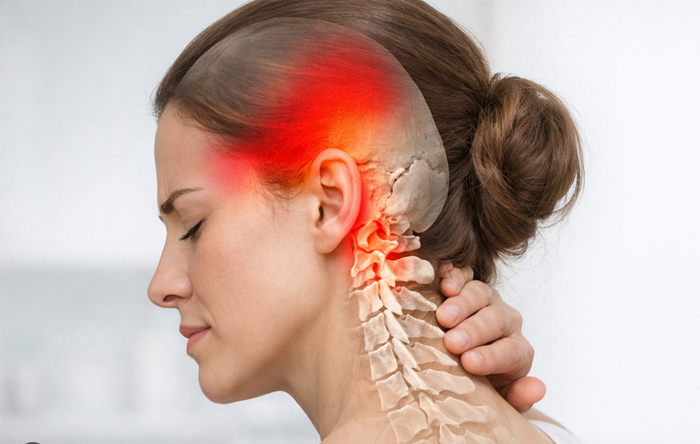
Cervicogenic headache is a secondary headache caused by disorders in the cervical spine, including joints, discs, muscles, or ligaments. It is often linked to poor posture, neck strain, nerve compression, or degeneration. Though uncommon, accurate diagnosis is essential to differentiate it from primary headache disorders.
Who Can Develop a Cervicogenic Headache?
Cervicogenic headaches commonly affect adults aged 30–50, especially those with neck injuries, poor posture, repetitive strain, or cervical degeneration. Office workers, drivers, athletes, and manual laborers are at higher risk, with women often experiencing greater stress-related symptoms.
Why Choose SpinenMantra for Headaches with Neck Pain?
At SpineMantra, our experts use advanced diagnostics and the evidence-based McKenzie/MDT approach to treat cervicogenic headaches. We provide personalised therapy, ergonomic guidance, and ongoing support to restore neck mobility, relieve pain, and promote lasting recovery.
- Psychogenic Stress & Anxiety
Chronic stress and anxiety induce a fight-or-flight response, causing trapezius, splenius, and suboccipital muscles to contract. Prolonged contraction increases tissue sensitivity, leading to pain at the back of the neck and skull. The constant muscle tension creates a tightening ‘band’ sensation and often radiates pain downward into the cervical spine.
- Sleep Deprivation & Fatigue
Poor-quality or insufficient sleep interferes with neuromuscular recovery and increases pain perception. When restorative sleep cycles are reduced, upper neck muscle fibres are not able to relax completely. The attendant micro-trauma and inflammation cause sensitisation of cervical nerves and magnify both head and neck pain upon awakening.
- Neuromuscular Feedback Loop
Tension headaches can trigger a vicious circle, constricting neck muscles irritate cervical nerve endings, which transmit pain signals to the brain. The brain reacts by contracting muscles even more to protect the spine, causing continued stiffness and referred pain between the head and neck.
Common (Usually Mild) Symptoms
- Stiff or tight neck muscles: A persistent feeling of tension or rigidity in the neck muscles.
- Decreased ability to turn or tilt your head: Limited range of motion when trying to move the head side to side or up and down.
- Occasional dizziness or lightheadedness: Intermittent sensations of imbalance or feeling faint, often linked to neck movement.
- Rapid Unexplained weight loss along with headaches may indicate a systemic or malignant condition requiring investigation.
Warning (Seek Medical Attention) Symptoms
- Stiff neck with fever: Neck stiffness with ongoing headache and/or high fever may signal a serious infection.
- Radiating pain or numbness: Pain or numbness extending to the face, arms, or shoulders could indicate nerve compression.
- Headache with weight loss: Unexplained weight loss and headaches may point to an underlying medical condition ( Red Flag Conditions).
- Neurological changes present: Vision issues, slurred speech, confusion, or seizures suggest possible brain involvement.
- Persistent nausea or vomiting: Continuous or recurring nausea and vomiting alongside headache may require urgent evaluation.
- Headache triggered by strain: Headaches brought on by physical exertion, coughing, or sexual activity may be warning signs.
- Post-injury neck pain: Neck pain and headache following trauma may indicate structural damage or concussion.
- Evidence-Based Conservative Care: Targeted physical therapy, ergonomic education, and home exercises to promote cervical mobility and release muscle tension, complemented by heat packs, gentle stretches, and manual techniques, with close monitoring and protocol adjustments as needed.
- Expert McKenzie-Led Protocol: Under the guidance of Saiantini Dey (PT), a credentialed McKenzie Therapist in Eastern India with over 2,000 successful cases, we employ systematic evaluation and self-management techniques to pinpoint and address mechanical causes of cervicogenic headache, empowering patients to maintain spinal alignment post-treatment.
- Advanced Physiotherapy Care: When initial treatments need enhancement, we employ targeted manual therapy, therapeutic exercises, and modalities like ultrasound or TENS to reduce pain and promote healing, avoiding invasive procedures.
- We support patients by collaborating with medical specialists when surgery is considered, but our focus remains on maximising recovery through evidence-based physiotherapy and conservative management.
At SpineMantra, our conservative approach focuses on therapeutic exercises, posture correction, and lifestyle advice to relieve pain, while medication management is coordinated through your physician as needed.
By combining these modalities under Dr. Dey’s experienced leadership, our multidisciplinary team at SpineMantra provides individualised, cutting-edge care, enabling patients to overcome cervicogenic headaches and regain their quality of life.
- Comprehensive Symptom Review
We begin with a detailed review of your headache frequency, neck pain, and possible triggers such as posture, movements, or prior injuries. We also ask about any associated symptoms, dizziness, visual disturbances, or sensory disturbances, to aid in the differentiation from migraine or tension-type headache.
- Physical and Functional Examination
A hands-on examination tests cervical range of motion, segmental joint play, and muscle tone. We assess pain with certain movements of the neck (e.g., rotation or extension) and palpate the upper cervical joints and suboccipital muscles to detect tender or hypomobile segments that refer to pain in the head.
- Rule-Out of Primary Headache Disorders
We use the International Classification of Headache Disorders (ICHD-3) criteria to confirm that your presentation is consistent with cervicogenic headache (e.g., unilateral headache, provoked by movement of the neck). This formalised system serves to rule out primary headaches like migraine or tension-type headaches.
- Imaging Studies For Structural Assessment
X-rays, CT scans, or an MRI are ordered for the cervical spine if needed to evaluate degenerative changes, disc pathology, or joint abnormalities. Though normal imaging studies cannot exclude the possibility of a cervicogenic headache, it does rule out any serious structural or neurological conditions that might require different treatment.
- Diagnostic Blocks
In equivocal presentations, controlled anaesthetic blocks of cervical facet joints or the greater occipital nerve might be considered. Pain relief, even if only temporary, following the injection confirms that the cervical spine is the pain generator, and clinches the diagnosis of a cervicogenic headache.
- Functional Mobility and Posture Assessment
Finally, we assess whether there are ergonomic factors, workstation setup issues, daily activities, or habitual postures which may be encouraging persistent strain on the neck. This complete evaluation means that both structural and functional causes are considered in formulating your treatment plan.