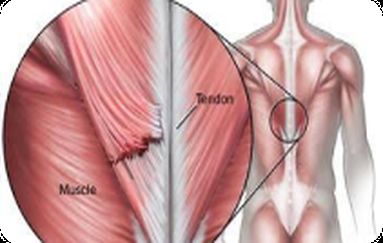
Muscle Strain
Muscle strain is an injury to the muscle–tendon unit caused by overstretching, sudden force, or excessive loading, resulting in tears within muscle fibers. Common symptoms include pain, swelling, stiffness, weakness, and reduced movement. Poor mechanics, overuse, fatigue, or improper technique are common causes. Accurate diagnosis is essential to guide rehabilitation and prevent recurrence.
Classification of Muscle Injuries
Grade I – Mild Muscle Strain
(< 5% of muscle fibers involved)
Clinical features include:
- Mild localized pain
- Minimal swelling or tenderness
- Little loss of strength or movement
Recovery:
- Usually heals within 1–3 weeks with proper rehabilitation
Grade II – Moderate (Partial) Muscle Tear
(30–50% of muscle fibers involved)
Clinical features include:
- Moderate pain and swelling
- Bruising and reduced strength
- Pain during movement and contraction
Recovery:
- Recovery typically takes 6–12 weeks
Grade III – Severe (Complete) Muscle Tear
(Complete rupture of muscle fibers)
Clinical features include:
- Severe pain and swelling
- Significant weakness or loss of function
- Possible palpable gap in the muscle
Recovery:
- Often requires surgery and prolonged rehabilitation
Why Choose SpineMantra for Muscle Injuries?
At SpineMantra, treatment focuses on accurate injury grading, movement analysis, load management, strengthening, and progressive rehabilitation to restore function safely and reduce the risk of re-injury.
- Rapid Thrust/Brake in sports
The other sporting activities, like football, cricket, and tennis, required impulsive acts of sprinting or stopping short. Such a sudden shift of muscle activity may lead to stretching or cause a tear of the muscle, particularly in the hamstrings, calves, or quadriceps.
- Squatting -Lifting Heavily Without Conditioning
The muscle-tendon unit can be overloaded by increasing the weight of a load or heavy objects without incremental strengthening training. It particularly poses a risk to the lower back and shoulders in addition to the thighs.
- Cold Weather Duty
Working out in the cold without warming up decreases blood circulation to the muscles and aids in stiffening them up and becoming strained, which can be triggered by joggers in the early hours and players of winter sports.
- Muscle balance of the antagonistic groups
In case one of the muscle groups (e.g. quadriceps) is significantly stronger than another (e.g. hamstrings), the weaker muscle is prone to rip when the activity is high-intensity.
- Going back to Activity Too Quickly After Injury
Failure to complete the healing process fully after an earlier strain means that the tissue remains weak and susceptible, and splits deeper at the second stretch.
- Acute Overextension
Upon acting on activities such as high kicks, dancing, and gymnastics, overstretching a muscle can lead to instant tearing of the muscle fibre, particularly when the person lacks flexibility.
- Direct, or Contact Injury
When there is a strong hit to the muscle in contact sports like rugby or kabaddi, the fibres can be crushed to the bones, causing acute swelling and internal haemorrhage.
- Sharp or Acute Pain-An acute, intense pain when injury occurs, which is often referred to as a pull or a pop in the muscle.
- Swelling and inflammation– The site of injury could be swollen just after a few hours, as there is a fluid accumulation and inflammation.
- Bruising or Discolouration– During the tear, the blood vessels may rupture, leaving obvious bruise marks close to the
- Muscle Weakness– The affected muscle will have a feeling of weakness, or they will be unable to support weight or fulfil their normal motions.
- Tenderness – Tenderness in a muscle strain refers to pain or discomfort felt when the affected muscle or surrounding tissue is touched or pressure is applied during palpation. It is a common and important clinical sign indicating underlying tissue injury and inflammation.
- Limited mobility -Having trouble stretching (or moving) the muscle through its full range of motion without pain.
- Muscle Spasms or Tightness–
In muscle strain, involuntary muscle spasms or a sensation of tightness may develop in and around the affected muscle. This occurs as a protective response to pain and inflammation, where increased muscle tone and reflex guarding help limit movement and prevent further tissue damage.
- Loss of Function – In extreme cases, the muscles cannot perform any functions at all, and this makes normal activities impossible.
At SpineMantra, muscle strain management follows a structured, phase-based rehabilitation model grounded in tissue healing science, load management principles, and functional restoration. The objective is not merely pain relief, but complete tissue recovery, strength restoration, and prevention of recurrence.
Treatment is individualised according to injury grade, stage of healing, activity demands, and patient goals.
- Acute Phase Management (Protection & Inflammation Control)
During the initial stage, the priority is to protect the injured fibres and minimise secondary tissue damage.
This phase may include:
- Relative rest (not complete immobilisation)
- Controlled activity modification
- Cryotherapy to manage inflammation
- Gentle compression where appropriate
- Pain-free range-of-motion exercises
Electrotherapy modalities such as ultrasound or laser may be used selectively to assist with pain control, but they are adjunctive — never the primary treatment strategy.
Early controlled movement is encouraged to prevent stiffness and promote optimal collagen alignment during healing.
- Early Rehabilitation Phase (Restoration of Mobility)
As acute pain subsides, carefully graded mobility exercises are introduced.
The goals in this phase are to:
- Restore pain-free range of motion
- Prevent scar tissue adhesions
- Reduce protective muscle guarding
- Maintain surrounding joint mobility
Stretching is introduced progressively and only within safe limits to avoid re-injury.
- Progressive Strength Rehabilitation
This is the most critical phase of recovery.
Strength rebuilding begins with low-load activation and progresses to controlled resistance training. Emphasis is placed on:
- Gradual loading of the healing muscle
- Eccentric strengthening (particularly important in hamstring and calf strains)
- Correction of muscle imbalances
- Improvement of neuromuscular control
- Endurance development
Rehabilitation is progression-based, not time-based. Advancement depends on tissue response and functional performance.
- Neuromuscular Re-education and Movement Correction
Many muscle strains occur due to faulty mechanics, poor coordination, or imbalance between muscle groups.
- At SpineMantra, we assess and correct:
- Movement asymmetry
- Improper lifting mechanics
- Core stability deficits
- Compensation patterns
- Return-to-sport biomechanics
If mechanical assessment indicates directional influence on symptoms, McKenzie-based principles are applied selectively to optimise movement patterns. The approach is used based on clinical indication — not as a routine protocol.
- Functional and Sport-Specific Reintegration
Before return to full activity, patients undergo functional retraining to ensure:
- Adequate strength symmetry
- Load tolerance
- Agility and coordination restoration
- Sport- or work-specific readiness
Rushing this phase is a major cause of recurrence. Clearance for return is based on objective performance criteria, not just pain reduction.
- Prevention and Long-Term Resilience
Prevention is integral to our treatment philosophy.
Patients receive guidance on:
- Proper warm-up strategies
- Gradual load progression
- Recovery scheduling
- Muscle balance maintenance
- Early symptom recognition
The goal is to build tissue capacity beyond pre-injury levels to reduce future strain risk.
Our Rehabilitation Philosophy
At SpineMantra, we do not rely on passive treatments alone. While supportive modalities may assist in the early phase, active rehabilitation remains the cornerstone of recovery.
We prioritise:
- Evidence-based progression
- Movement intelligence
- Patient education
- Independence from repeated clinic dependency
- Sustainable strength restoration
Muscle healing is not just about time — it is about appropriate loading, structured progression, and biomechanical correction.
Our objective is complete recovery, safe return, and long-term resilience.
Accurate diagnosis is the foundation of effective recovery. At SpineMantra, muscle injuries are evaluated through a structured clinical process designed to determine the severity of tissue damage, identify contributing mechanical factors, and guide safe rehabilitation.
Our goal is not only to confirm the presence of a strain, but to understand its grade, underlying cause, and functional impact.
Step 1 – Detailed Clinical History
Assessment begins with a comprehensive history-taking process. We analyse:
- Mechanism of injury (sudden vs gradual onset)
- Nature and location of pain
- Previous history of strain or recurrence
- Activity demands (sport, occupation, daily tasks)
- Timing and progression of symptoms
This helps differentiate between an acute strain, chronic overuse injury, or recurrent tissue overload.
Step 2 – Focused Physical Examination
A thorough physical examination is performed to evaluate:
- Localised tenderness
- Swelling or bruising
- Range of motion limitations
- Strength deficits
- Pain during resisted contraction
- Functional movement patterns
Specific resisted tests help isolate the affected muscle and assess the degree of structural involvement. This step is critical in clinically grading the injury as Grade I, II, or III.
Step 3 – Imaging (When Clinically Indicated)
Imaging studies such as ultrasound or MRI are recommended selectively, particularly in moderate to severe injuries or when a complete tear is suspected.
Imaging helps:
- Confirm fibre disruption
- Assess the extent of tearing
- Rule out associated ligament or tendon injury
- Guide prognosis in high-demand athletes
However, imaging is used to support — not replace — clinical assessment.
Step 4 – Mechanical and Movement Assessment
Beyond identifying the tear itself, we assess the mechanical factors that may have contributed to the injury.
SpineMantra is led by Eastern India’s first Credentialed MDT clinician, and mechanical evaluation principles are incorporated when appropriate. This includes assessing movement patterns, load distribution, and muscle imbalance that may predispose to strain.
The McKenzie Method is applied selectively when symptoms demonstrate mechanical responsiveness. It is not used routinely for all muscle injuries but serves as a valuable framework when directional loading influences pain behaviour.
This movement-based evaluation helps reduce recurrence risk by addressing root mechanical causes rather than focusing solely on tissue healing.
Step 5 – Individualised Rehabilitation Planning
Once diagnosis and grading are confirmed, a structured and individualised treatment plan is created.
The plan considers:
- Severity of injury
- Stage of tissue healing
- Functional demands
- Return-to-sport or work requirements
- Risk factors for recurrence
Rehabilitation focuses on controlled loading, progressive strengthening, correction of contributing biomechanical factors, and safe return to activity.
Clinical Perspective
Muscle strains are among the most common musculoskeletal injuries, particularly in active individuals. However, recurrence rates remain high when grading is inaccurate or rehabilitation is incomplete. At SpineMantra, careful assessment and structured progression form the core of successful recovery.